

How to Grow Long Hair: A Tacoma Salon Guide
If you want to know how to grow long hair, start with the length you already have rather than a promise of faster growth. Scalp hair spends 2 to 6 years in its growing phase, and about 50 to 100 scalp hairs finish their cycle and fall out each day, according to the MSD Manual. A realistic plan keeps the hair you are growing from breaking off before you can see it. At Dolce Salon, that plan starts with a consultation, not a guaranteed timeline.
Call Dolce Salon at (253) 272-0378 to talk through a length goal before you book.
How to grow long hair starts with a realistic rate
The MSD Manual describes scalp hair as having a growing phase of 2 to 6 years, then a short transition and a resting phase. At the end of the rest, the hair falls out and a new hair starts in the same follicle. Eyebrows and eyelashes grow for only 1 to 6 months, which is why those hairs never reach the length scalp hair can. Two clients can follow similar care and still reach different lengths, because the growing phase is not the same for everyone.
A clinical reference, StatPearls, puts ordinary scalp growth near 0.35 millimeters a day, a little over a centimeter a month. Treat that as a planning figure, not a promise your hair will match. Genetics, age, health, and the length of the growing phase all change the ceiling, so no salon visit, oil, or wash schedule can guarantee a faster rate.
Search results often promise long hair in a week or overnight. Those claims describe styling, extensions, or a photo angle. They do not describe the follicle. At Dolce Salon, the useful conversation is what your hair can hold between appointments, and what would make the ends break before that length shows.
How to grow long hair when breakage keeps the length the same
Hair grows from the scalp. The ends you see in the mirror are older hair that has already been washed, brushed, tied up, and maybe colored. If those ends snap, a month of new growth can disappear before you notice it. The hair looks like it is standing still, when it is often growing and breaking at the same time.
Normal shedding and true loss are different. The American Academy of Dermatology says it is normal to shed 50 to 100 hairs a day. Extra shedding often starts a few months after a stress such as illness, surgery, a large weight change, or giving birth, and it often settles as the body recovers. Hair loss is different: something is stopping growth, including styles that pull on the hair or harsh hair-care products. A salon can look at breakage. A dermatologist is the right person if you are worried about how much hair is coming out.
What breakage looks like at home
Ends feel dry or fuzzy a few weeks after a cut, not just the day you washed.
The outline looks uneven even though you asked for one length.
Short pieces show up on your clothes, while the hairs in the shower still look long.
A ponytail feels thinner at the ends than it did at the last appointment.
Those signs point to the ends, not to a follicle that stopped working. A stylist can tell you whether a light dusting is enough or whether the ends need more taken off so the rest can stay.
Trims protect length, but they do not speed growth
A trim does not make hair grow faster. It removes the part that would split higher and take more length with it. That is the whole job of a dusting: a small amount off the ends so the hair you are growing has a cleaner edge.
How often is personal. Fine hair that tangles, hair that is lightened, and hair worn in the same tight style every day usually need a look sooner than hair that is rarely heated. If your goal is length, say that at the chair. A shape cut and a dusting are different requests. One changes the outline. The other tries to keep it.
Bring a photo of the length you want and a photo of your hair on a normal day, not only on a styled day. A stylist can see whether the ends are the problem or whether the shape you want would require cutting into healthy hair. If you like the length and only the tips look rough, ask for a dusting and say you want to keep the perimeter. If one side is already shorter because it rubs a bag strap or a coat collar, point that out. That side may need a little more taken off so the rest does not keep catching.
Skip the urge to cut it all off after one bad hair week. One rough wash, a humid day, or a ponytail dent is not the same as split ends. Look at the hair dry, in daylight, and separate a few sections. If you see a white dot or a fray that splits into two, that spot is a candidate for the trim. If the hair is only bent from a braid, a different tie will tell you more than scissors will.
On Dolce's services page, prices are a starting point and can go up. A haircut added to a color service is listed as its own amount by stylist level. There is no single growth-trim price, and there should not be. The right amount to cut depends on the ends in front of the stylist that day.
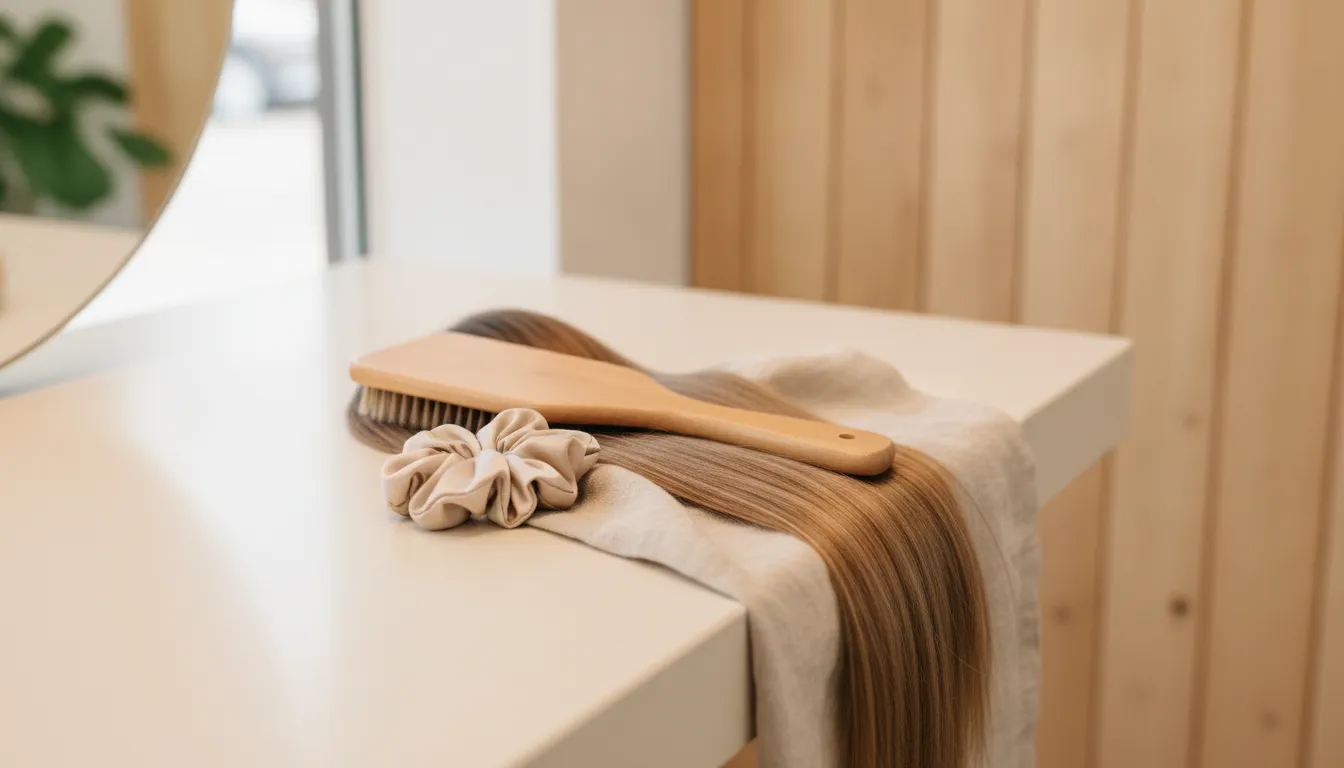
Daily habits that keep new growth on your head
These habits do not change how fast the follicle grows. They make it more likely that the growth stays long enough to see. Pick one change you will actually keep. A long list you abandon in a week does less than a single habit that lasts through the next appointment.
Heat and wet hair
High heat on the same section, every day, is a common reason ends rough up. If you blow-dry, keep the tool moving and use a heat protectant you already like. Pause if you smell heat or see the ends go cloudy. Air drying is gentler, but hair left soaking in a tight elastic can break too. A loose hold while it dries is enough. Sleeping on a smooth pillowcase reduces the friction that roughs the lengths overnight, which matters more once the hair passes your shoulders and spends the night under you.
How you tie it
The American Academy of Dermatology lists hairstyles that pull on the hair as a cause of hair loss, because the pulling can stop growth until it stops. A sleek ponytail for a dinner is different from the same tight style every day at the same spot. Alternate the placement. Use a soft tie. If your scalp is tender at the hairline, loosen the style before you wait for a bald spot to prove the point.
Detangling and washing
Start at the ends and work up. Yanking a brush from the scalp down tears the oldest hair first. Wash often enough that your scalp feels comfortable, not on a schedule copied from someone else's hair. There is no Dolce rule that skipping washes grows hair. There is a practical one: detangle before the shampoo, and do not scrub the lengths the way you scrub the scalp.
Food, supplements, and sudden shed
The hair shaft is dead protein once it leaves the scalp. MedlinePlus lists crash diets that do not contain enough protein among the stresses that can trigger a heavy shed, and it says a person normally loses roughly 50 to 200 hairs a day. That is not a reason to start a supplement because a video said it grows hair. If shedding jumped after an illness or a diet change, talk with a clinician. A stylist can help you keep the hair you have while you sort out the health question. A stylist cannot diagnose it.
Color, smoothing, and extensions while you grow length
You can grow long hair and still color it. You just need an honest plan for the stress that color adds. Lightening lifts pigment and can leave the ends drier. A consultation is where Dolce looks at goals, lifestyle, and a maintenance plan, then builds a formula around that. It is also where extras, including treatments, get added if the hair needs them. Confirm the current starting price when you book. Do not treat an old screenshot as the quote.
A smoothing treatment is not a growth treatment. Dolce's keratin service is described on the services page as a treatment that increases manageability for up to 5 months. That wording is about frizz and how the hair behaves, not about how long the treatment lasts and not about new growth. Read the keratin treatment guide if you are deciding whether smoother hair would help you wear it down while the length catches up.
Extensions add length on the day you get them. They do not replace the growth happening at your scalp. The live services page lists Tap-In, Cold Fusion, Handtied, and Hot Fusion, and each method needs a consultation for a price quote. Wear time differs by method, and a method that pulls can work against the hair you are trying to keep. If damage is the worry, start with whether extensions damage hair, then how to care for extensions once a method is actually chosen. This article does not compare those methods.
How to grow long hair with a Dolce consultation
A first visit at Dolce begins with a consultation about hair goals, lifestyle, and maintenance. That includes what you are not loving and what keeps getting in the way. Bring the length question into that conversation instead of hoping the stylist guesses it.
Ask which ends are breaking and which are only dry.
Ask how much a dusting would remove versus a shape you would notice.
Ask whether color or a smoothing treatment fits a length goal, or whether it should wait.
Ask what home step would matter most for your hair, not a 12-step routine.
If you want length now, ask whether extensions make sense or whether they would stress the hair you are growing.
You can see who is on the floor on the team page. Heather Trout, the owner, is a master stylist with a background in extensions, color, haircuts, and updos. Level and price are part of the booking choice. The new client page is the place to match a session to what you actually want, especially if you are not sure whether you need a cut, color, or a longer consultation.
Dolce does not confirm a growth timeline, and this guide will not invent one. The appointment is for a plan you can keep.
A simple length check you can repeat
Measure once, then leave it alone for a couple of months. A weekly tape-measure habit usually measures a different ponytail spot, not new growth. If you want a repeatable check, do it the same way each time.
Tie the hair where you normally wear it, then mark that spot with the same soft tie.
Measure from that spot to the ends, not from a new place on the crown.
Note whether the ends look smooth or fuzzy on that same day.
Wait at least eight weeks before you measure again.
Compare the number and the ends together. A shorter number with frayed ends is breakage. A similar number with a sudden increase in shed hairs is a question for a dermatologist.
Habit | What it protects | What it does not do |
Dusting the ends when they fuzz. | Keeps a split from traveling up the hair shaft. | Does not make the scalp grow hair faster. |
Lower heat and a protectant. | Keeps the older lengths from snapping. | Does not add inches at the root. |
Looser, rotated ties. | Reduces pulling that the AAD links to hair loss. | Does not change your growth phase. |
Detangle from the ends. | Saves the hair that has already grown. | Does not replace a trim when ends are split. |
Consultation before color or extensions. | Matches the service to a length goal. | Does not guarantee a finish date. |
If the measure has not changed and the ends look frayed, you are likely losing length to breakage. If the measure has not changed and you are also seeing much more hair in the shower than usual, that is a shedding question for a dermatologist, not a new shampoo.
Frequently asked questions
How long does it take to grow long hair?
Scalp hair can stay in its growing phase for 2 to 6 years, and a published medical reference puts ordinary growth near 0.35 millimeters a day. Breakage can erase that progress. Nobody can promise the date your hair will reach a certain point.
Do trims make hair grow faster?
No. Trims remove damaged ends so the rest is less likely to split higher. They do not change the follicle.
Can I grow long hair if I color it?
Yes, if the color plan respects the ends. Lightening is more stressful than a deposit of a similar or darker shade. Talk through maintenance at the consultation and confirm the current starting price when you book.
Should I get extensions while I grow my own hair?
Only if a consultation says your hair can hold the method. Extensions change the length you see immediately. They are a separate service from growing out your own hair, and the price is quoted after that conversation.
When is shedding a reason to call a doctor?
Shedding 50 to 100 hairs a day can be normal. Call a dermatologist if the shed is sudden, comes with patches, or follows illness, a big weight change, or a new medication. Call the salon when you want help keeping the lengths you still have.
Call (253) 272-0378 and tell Dolce you are growing your hair out. The stylist can look at the ends and help you book only what that goal needs.


Comments